Chia de Gracia
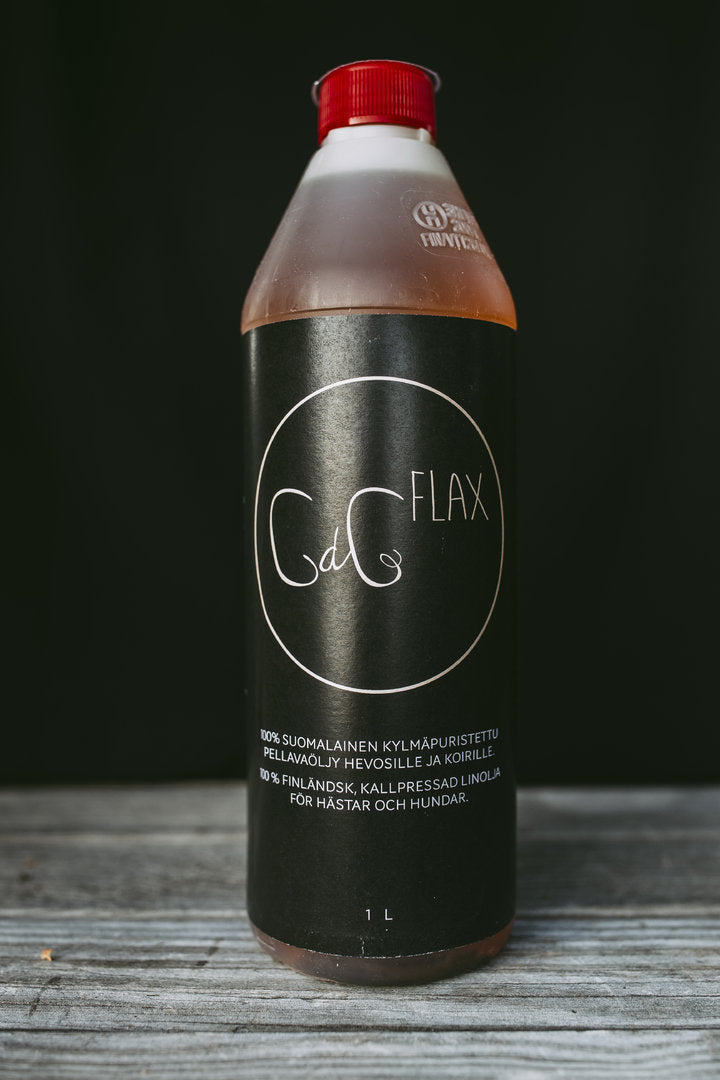
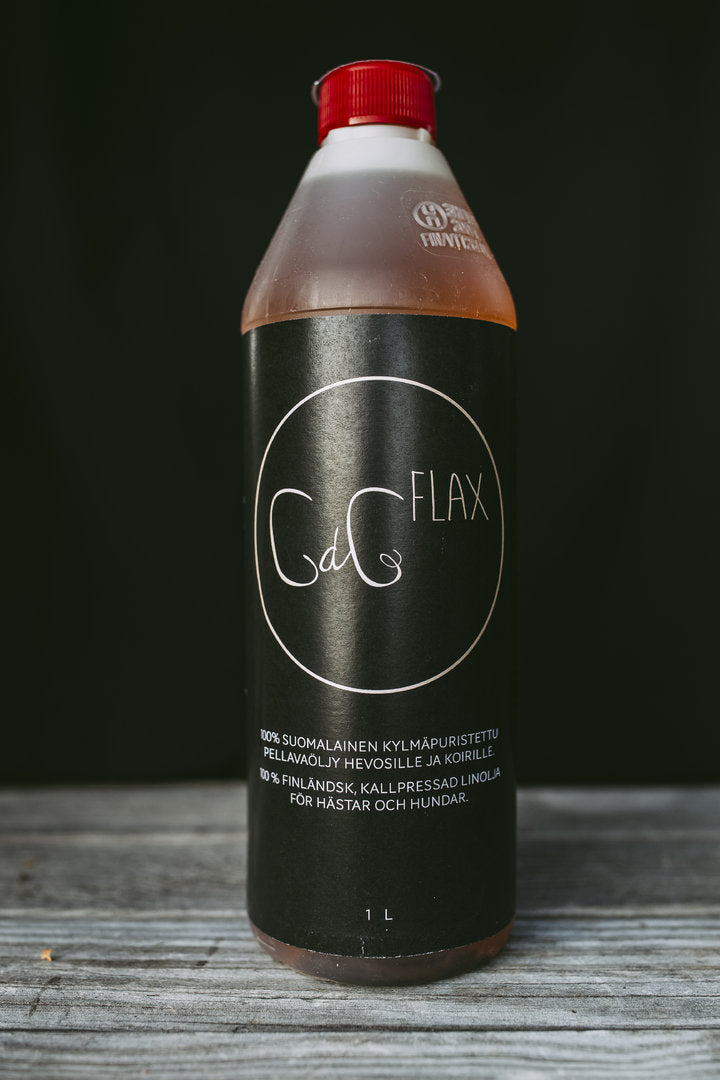
CdG Flax: Coldpresses Flax Seed Oil 1 l
Delivery time 5-7 days
Couldn't load pickup availability
CdG Flaxseed Oil
100% Finnish cold-pressed linseed oil for horses and dogs
Fatty acids are an important part of the daily nutrition of horses and dogs – and are also linked to the well-being of the skin, coat, and tissues.
Product introduction
CdG Flaxseed Oil is a 100% Finnish cold-pressed linseed oil for horses and dogs.
Linseed oil is one of the most widely used plant-based oils when you want to add fat to the diet and complement the fatty acid composition in a natural way.
Linseed oil
Linseed oil is rich in unsaturated fatty acids, a significant proportion of which is alpha-linolenic acid (ALA), an omega-3 fatty acid.
Omega-3 and omega-6 are essential fatty acids that the horse and dog cannot produce on their own and must obtain from their diet.
Fatty acids are part of the cell membrane structure and belong to the animal's daily nutrition.
Nutritional perspective
Fats are an important part of the horse's and dog's feeding and serve as a concentrated energy source.
Linseed oil provides an omega-3-rich fatty acid composition to the diet.
Omega fatty acids are part of the cell structure and also belong to the structural fatty acids of the skin, coat, and tissues, such as the joints.
The fatty acid composition of the skin and coat is part of the animal's nutrition, and it is directly related to the amount and ratio of fatty acids obtained from the diet.
In studies conducted on dogs, omega fatty acids have also been examined in the context of joint nutrition and metabolism.
Attention should be paid to the ratio of fatty acids (omega-3 and omega-6) as part of the overall diet.
Plant oils, such as linseed oil, are a typical way to complement the fatty acid profile of the diet.
Composition
Cold-pressed linseed oil (Linum usitatissimum) 100 %
Manufactured and packaged in Finland
Use in feeding
Linseed oil is used as part of the diet, for example:
– To increase energy content
– To complement the fatty acid composition
– For a varied and diverse diet
– When you want to pay attention to skin and coat condition
Please note that the use of oil in the diet increases the need for vitamin E.
Dosage
Horse:
2–4 tbsp / day
According to energy needs 2–5 dl / day
Dog:
Approx. 15 ml / day or about 5 % of the feed portion weight
Maximum 15 % of the daily food portion
Nutritional content
Crude fat 100 %
– of which alpha-linolenic acid (omega-3) 62 %
– linoleic acid (omega-6) 16 %
Carbohydrates 0 %
Protein 0 %
Salt 0 %
Metabolisable energy
Horse: 32,5 MJ/kg/DM
Dog: 35,6 MJ/kg/DM
Background information and studies
The role of omega fatty acids in animal nutrition has been examined in numerous studies, particularly from the perspectives of fatty acid composition, overall diet, and tissue structure.
-
Examples of related studies:
- Sembratowicz, I. et al. (2020). Effect of dietary flaxseed oil supplementation on biochemical and haematological parameters of horses.
→ The use of linseed oil in the diet was associated with changes in fatty acid composition and blood values
- Farahani, H.G.M. et al. (2023). Effects of flaxseed oil supplementation on nutrient digestibility in horses.
→ Linseed oil can be included in the diet without affecting nutrient digestibility - Hartwig, S. et al. (2025). Effects of dietary plant oils on skin fatty acid profile in horses.
→ The addition of omega-3 fatty acids to the diet was reflected in the skin's fatty acid composition - Richards, T. et al. (2022). Effects of camelina, flaxseed and canola oil supplementation on skin and coat parameters in dogs.
→ Omega fatty acids from plant oils have also been examined in the context of skin and coat in dogs - Burron, S. et al. (2024). The balance of n-6 and n-3 fatty acids in companion animals.
→ The significance of omega fatty acids is related to their role as part of the animal's fatty acid composition
Share