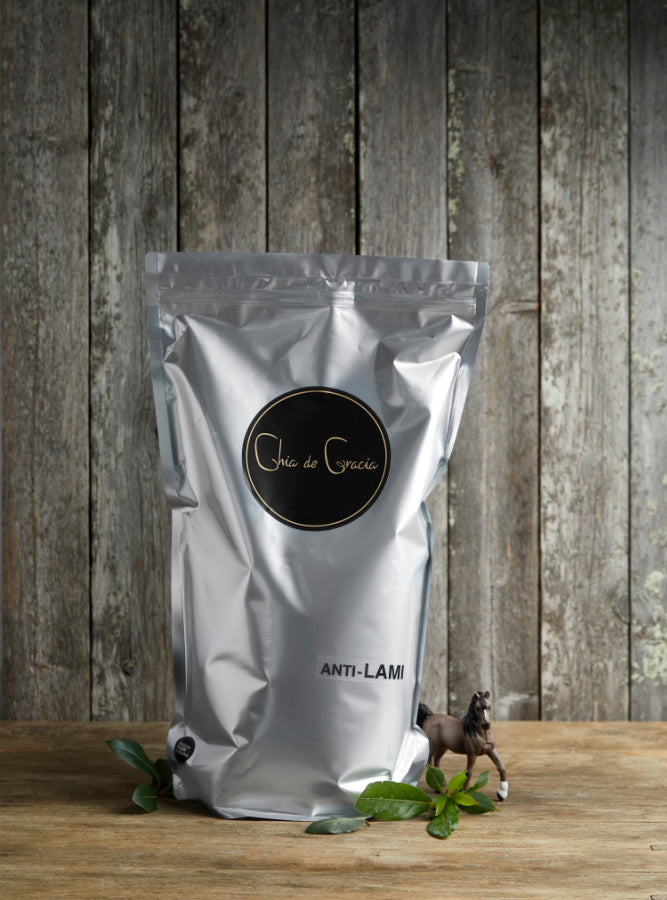

Chia de Gracia EN
Anti-Lami 2,5 kg
Delivery time 5-7 days
Couldn't load pickup availability
Anti-Lami – 100 % natural herbal blend for dietary transition periods
A horse's digestion is sensitive to changes. Throughout the year, the diet often changes, for example when transitioning from winter indoor feeding to pasture or back to stable feeding. Changes in hay, the addition of concentrate feed, or other dietary changes can also alter the overall diet.
In nature, a horse eats small amounts of varied plant nutrition throughout the day. In stable conditions, the diet is often more limited and changes can be more significant. This is why dietary changes are usually made gradually, so that the horse's digestion has time to adapt to the new feed.
Digestion and microbiota
A horse's digestion is largely based on microbial activity in the large intestine. The large intestine is home to a vast number of microbes that break down plant fibre and participate in nutrient processing as part of the horse's normal digestion.
The gut microbiota gradually adapts to the horse's diet. When feeds change, for example when transitioning to pasture grass or new hay, the microbiota also gradually begins to adapt to the new type of nutrition. For this reason, dietary changes are usually made gradually so that digestion has time to adjust to the change.
In spring, when the grazing season begins, the diet often changes rapidly. Fresh pasture grass naturally contains abundant easily digestible carbohydrates, such as sugars and fructans. There can also be significant differences in sugar and fibre content between different hay batches.
Anti-Lami is a versatile herbal and seed blend that adds a variety of plants, fibres, and nutrients to the horse's diet, especially during times when the diet is changing.
Nutritional composition
The raw materials in the blend naturally contain, among other things, plant fibre, protein, fatty acids, minerals, plant compounds known as polyphenols, bitter compounds, and several aromatic plant compounds.
A versatile herbal blend brings plant-derived nutrients and compounds to the diet that are naturally found in the plants themselves.
Fibre as part of the horse's diet
A horse's digestion is largely based on plant fibre. A large portion of the nutrition is processed in the large intestine, where gut microbes break down plant fibre and utilise it as part of the normal digestive processes.
In a plant-based diet, fibre is obtained primarily from hay, but seeds, leaves, and other plants also naturally contain various types of fibre.
For example, chia seeds and fenugreek seeds contain abundant plant fibre as well as plant-based nutrients. In herbal blends, such plants add fibre and plant-derived nutrients to the diet.
Composition
Anti-Lami contains chia seeds, hawthorn berries, milk thistle seeds, bilberry leaf, brewer's yeast, fenugreek seeds, nettle, cleavers, artichoke, Himalayan salt, garlic, and a pinch of love 🧡
When to use?
Herbal blends are often used in situations where the horse's diet is changing.
Typical situations may include, for example:
-
in spring before the grazing season begins
-
during the grazing season
-
when the diet is changing
-
when hay or concentrate feed is changed
-
periodically as a course, as part of a varied diet
Dosage
Horse approx. 500 kg:
During a dietary transition
1–1,5 dl per day.
For maintenance during dietary changes
0,5–¾ dl per day.
1 dl ≈ 45 g
Average nutritional values
Crude protein 18 %, Crude fat 9,5 %, Crude fibre 14,8 %, Ash 12 %, Sodium 4 %, Moisture 7 %
Share