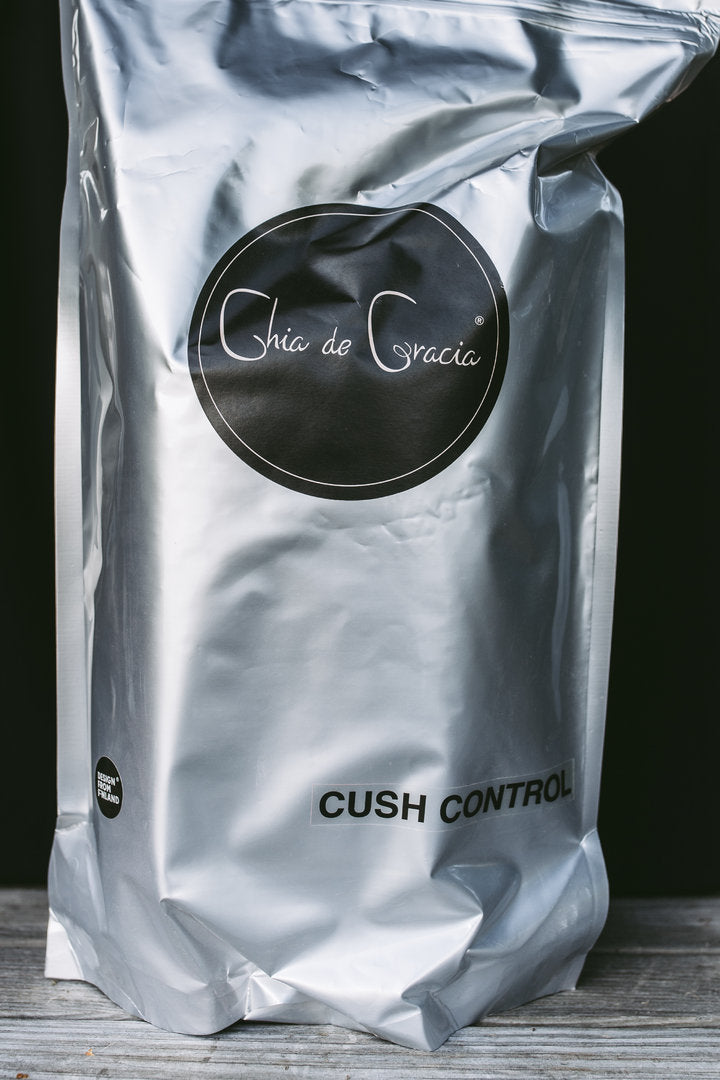


Chia de Gracia
Cush Contol 2,2 kg
Delivery time 5-7 days
Couldn't load pickup availability
Cush Control – herbal blend for your horse's varied diet
Cush Control is a 100% natural, versatile herbal blend that brings plant-based variety to your horse's diet through a blend of seeds, leaves, and roots. The blend contains plants that have been traditionally used as part of horses' traditional herbal feeding.
Plant-based herbal blends bring nutrients and compounds naturally found in plants to the diet, such as polyphenols, bitter compounds, and aromatic compounds. The blend also naturally contains various compounds known as plant antioxidants.
Feeding considerations for the ageing horse
Many horse owners notice that as their horse ages, they start paying more attention to its diet. As a horse ages, various changes gradually occur in its body, which may be reflected in the coat, energy levels, or overall vitality. This is when the importance of feeding also becomes more prominent.
When feeding older horses, particular attention is often paid to the composition of feeds and the consistency of the diet. Feeds and supplementary foods with moderate sugar and starch content that bring herbal-based variety to the diet are often preferred.
Plant-based herbal blends are often naturally low in sugar and starch, as they mainly consist of dried leaves, roots, and seeds.
Composition
Cush Control contains chasteberry, milk thistle seeds, goat's rue, ginkgo, bilberry leaves, brewer's yeast, artichoke, goldenrod, grape seeds, and a pinch of love 🧡
Compounds known as plant antioxidants
Many plants naturally contain plant compounds known as polyphenols. These compounds are found in, for example, berries, seeds, and leaves.
For example, grape seeds, bilberry leaves, and ginkgo naturally contain polyphenols and other compounds naturally found in plants. Milk thistle seed naturally contains plant compounds belonging to flavonoids, known as silymarin. Such plants bring plant-based nutrients and compounds to the diet that are naturally found in various plants.
Nutritional composition of the herbs
The herbs in Cush Control naturally contain, among others, plant fibre, plant protein, minerals, plant compounds known as polyphenols, bitter compounds, and aromatic plant compounds.
A versatile herbal blend brings many plant-derived nutrients and compounds to the diet that are naturally found in plants.
Dosage
Horse approx. 500 kg
1–2 dl per day.
1 dl ≈ 30 g
Mix into the regular feed.
Average nutritional values / 100 g
Crude protein 15 %, Crude fat 7 %, Crude fibre 27 %, Ash 8 %, Moisture 9 %, Sugar 7 %, Starch 3 %
Studies
Chasteberry (Vitex agnus-castus) is a plant whose compounds and biological properties have been examined in several botanical studies. The plant has also been studied in the context of equine pituitary pars intermedia dysfunction (PPID).
Bradaric et al. (2013) examined the use of a chasteberry-containing preparation in 38 horses and ponies diagnosed with PPID. The study monitored the animals' clinical parameters over a six-month period.
Beech et al. (2002) compared Vitex agnus-castus extract with pergolide treatment in PPID horses. The study examined, among other things, clinical parameters and hormone levels.
In addition, review articles on PPID in horses have examined various nutritional and complementary approaches, in which chasteberry is mentioned as one of the plants studied.
Equine PPID has also been extensively covered in several veterinary review articles that examine the underlying mechanisms, diagnostics, and treatment options of the disease (including McFarlane 2011; Durham & Frank 2014).
The studies are used for understanding the background information and the known composition of the plant.
References
Bradaric, Z., May, A., & Gehlen, H. (2013)
Use of the chasteberry preparation Corticosal® for the treatment of pituitary pars intermedia dysfunction in horses.
Beech, J., Donaldson, L., et al. (2002)
Comparison of Vitex agnus-castus extract and pergolide in treatment of equine Cushing's syndrome.
McFarlane, D. (2011)
Equine pituitary pars intermedia dysfunction. Veterinary Clinics of North America: Equine Practice.
Durham, A., & Frank, N. (2014)
Pituitary pars intermedia dysfunction: diagnosis and management. Equine Veterinary Education.
Menzies-Gow, N., et al. (2025)
Review of pituitary pars intermedia dysfunction in horses.
Share