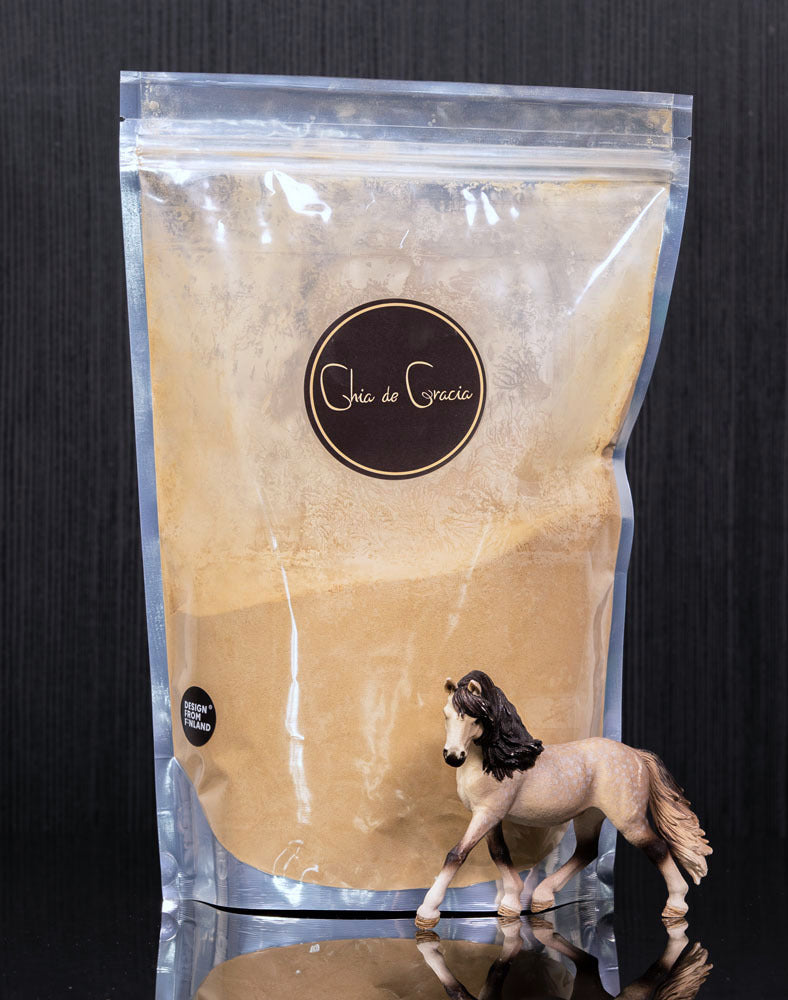
Lecithin for horses
Lecithin is a natural fatty substance that occurs in the horse's body as part of the normal structure of cell membranes and fats. In feeding, lecithin is used especially when you want to support fat metabolism and the normal function of the mucous membranes of the digestive tract.
Lecithin consists of phospholipids, which are compounds familiar to the body and are part of, among other things, the structure of cell membranes. For this reason, lecithin is well suited as part of the horse's daily diet.
Lecithin and the digestive tract
Lecithin is used in feeding in situations where attention is to be paid to the mucous membranes of the stomach and digestive tract. The phospholipids in lecithin participate in the transport of fats and form physical structures in the digestive tract that are associated with the normal surface structure of the mucous membranes.
Studies and animal experiments have described the coating property of lecithin, i.e. its ability to form a water-repellent surface layer on top of the mucous membrane. This phenomenon is based on the structure of lecithin and the phospholipids it contains.
Lecithin as part of the diet
Lecithin is a common ingredient in complementary feeds that take into account the nutritional balance of the stomach and digestive tract. In many equine feeding solutions, lecithin is used together with pectin, as these two dietary fibre- and fat-derived ingredients complement each other structurally.
The phosphatidylcholine in lecithin belongs to the phospholipids that participate in fat processing in the digestive tract. For this reason, lecithin is also often associated with the nutritional context of fat-soluble vitamins (A, D and E).
Dosage:
Horse (approx. 500 kg):
2–5 tbsp / day
In situations related to stomach support in feeding:
50–150 g / day, as a course for 2–4 weeks.
1 dl ≈ 45 g
Always start with a small dose.
The dose can be divided across multiple feedings.
Instructions for use: Moisten and mix into the regular feed.
Do not feed dry.
Tip: Pectin (e.g. from apple) is often combined with lecithin as part of stomach-related feeding solutions.
Nutritional content (average / 100 g): Fat 84,0 g, of which saturated 12,0 g, Carbohydrates 3,0 g, sugars 3,0 g, Protein 0,05 g, Salt 0,75 g (sodium 0,30 g), Calcium 0,14 mg
Background information and studies
Lecithin and lecithin–pectin combinations have been examined in equine nutrition, particularly in studies related to the structure of the stomach and digestive tract.
Lybbert, T. et al. (2007). Effects of a pectin–lecithin complex on gastric ulceration in horses. Journal of Equine Veterinary Science.
Sanz, M. G., Viljoen, A., Saulez, M. N., et al. (2014). Efficacy of a pectin–lecithin complex for treatment and prevention of gastric ulcers in horses. Veterinary Record.
Venner, M., Lauffs, S., Deegen, E. (1999). Treatment of gastric lesions in horses with a pectin–lecithin complex. Equine Veterinary Journal Supplement.
Verry, F. et al. (2020). The role of soluble fibres in gastric protection and gastric emptying in horses.
In addition, the phospholipids of lecithin and their surface-structure-related properties have been studied in numerous animal experiments and nutritional studies (including Lichtenberger et al., Hills et al., Kiviluoto et al.).