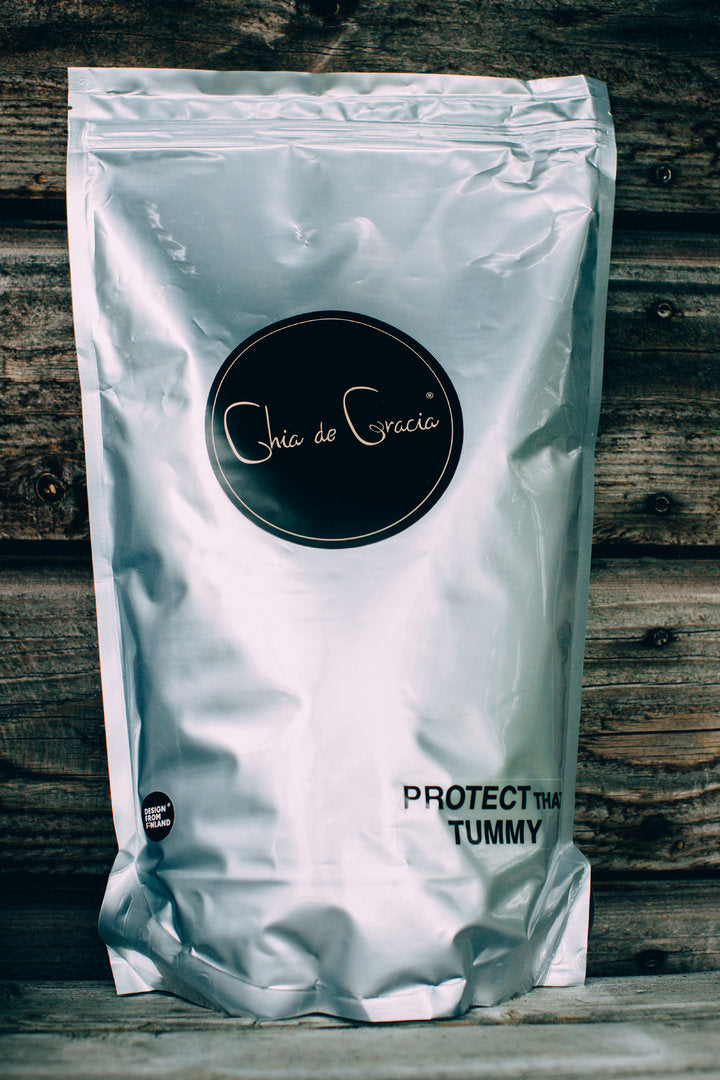
Chia de Gracia
Protect That Tummy
Delivery time 5-7 days
Couldn't load pickup availability
Protect That Tummy – when your horse's stomach doesn't feel quite right
Tummy troubles? Feeling off?
Many horse owners recognise situations where their horse's demeanour changes.
Tension increases, cooperation doesn't feel the same, appetite fluctuates, or performance isn't quite up to par.
Everyday changes – such as long intervals between feeds, transport, competitions, a change of yard, or other stress – can particularly affect digestion.
The horse's stomach produces acid continuously, and under natural conditions a horse eats almost non-stop. When this rhythm is disrupted, the stomach's balance can also fluctuate.
Why Protect That Tummy
Protect That Tummy is a 100 % natural feed blend that brings soft, mucilaginous fibres, phospholipids and yeasts to the diet as part of a balanced diet.
The blend is designed especially for situations where:
- feeding intervals vary
- daily life involves stress or strain
- the horse's stomach is sensitive
- you want to add softness and balance to the diet
What happens in practice
Soluble plant fibres, such as pectin and fenugreek, bind water and swell to form a soft, mucilaginous structure.
When the blend is mixed with water, it forms a soft, gel-like mass that travels through the digestive tract along with the rest of the feed. It makes the feed mass smoother, more mucilaginous and easier to move through.
This type of soluble fibre raw material is often used in feeding when special attention is desired for stomach well-being.
Ingredients – clearly and practically
Pectin
Forms a soft, viscous, gel-like structure in water. One of the best-known soluble fibres.
Fenugreek
Swells in water and forms a mucilaginous structure.
Inulin
A plant fibre that serves as nutrition for gut microbes and adds fibre-based balance to the diet.
Lecithin
Contains phospholipids, which are part of cell surface structures and a natural component of the digestive tract.
Brewer's yeast (Saccharomyces cerevisiae)
A well-known part of equine feeding, particularly from the perspective of gut microbial activity.
Rosehip
Naturally contains fibre (including pectin) as well as compounds naturally found in plants.
Contains: inulin, lecithin, fenugreek, pectin, brewer's yeast, rosehip, and a pinch of love 🧡
When to choose this
Many choose Protect That Tummy:
- during competition season
- in connection with transport
- during changes in feeding
- for horses with sensitive stomachs
- or when they want to support the overall diet from a stomach perspective
Dosage:
Horse approx. 500 kg:
1–2 dl / day
Soak and mix into the regular feed.
Do not feed dry.
1 dl ≈ 55 g
The dose can be divided into two feedings.
Not recommended for pregnant animals.
Average nutritional values / 100 g
Metabolisable energy 10,5 MJ/kg
Crude protein 14 %, Crude fat 8 %, Crude fibre 25 %, Ash 8 %, Moisture 8,5 %, Sugar 5 %, Starch 1 %
Studies and background
The raw materials in Protect That Tummy have been examined in several studies related to equine feeding – particularly from the perspective of feed mass structure, water binding by fibres, and gut microbial activity.
Pectin–lecithin combination
Equine studies have described that pectin forms a gel-like structure in an acidic environment, while lecithin (phospholipids) affects the interfaces between liquid and fat.
Together, these form a layered and gel-like structure within the feed mass in the stomach, which relates to how feed settles and moves in different parts of the stomach.
Soluble fibres (pectin, inulin)
Nutritional studies have described that soluble fibres bind water, swell and form a soft, gel-like mass in the digestive tract. At the same time, they are fermented in the large intestine by microbes – this is a central part of the horse's normal digestion.
Yeasts (Saccharomyces cerevisiae)
In equine studies, the use of yeasts has been examined particularly from the perspective of gut microbiota. Studies have described that yeasts can influence fibre-utilising microbes and thereby feed digestibility and nutrient utilisation.
What these studies have in common is that they describe feed mass structure, water binding and microbial activity – i.e. phenomena that are part of the horse's normal digestive function and overall diet.
References
Lauffs, S. (1998)
Behandlung von Magenschleimhautläsionen beim Pferd mit einem Pektin-Lecithin-Komplex – klinische und gastroskopische Untersuchungen.
Tierärztliche Hochschule Hannover.
Murray, M.J., Schusser, G.F., Pipers, F.S., Gross, S.J. (1999)
Factors associated with gastric lesions in Thoroughbred racehorses.
Equine Veterinary Journal.
Julliand, V., Grimm, P. (2017)
The impact of diet on the hindgut microbiome and digestive health of the horse.
Animal.
Harris, P., Ellis, A., Fradinho, M. et al. (2017)
Review: Feeding conserved forage to horses and digestive physiology.
Animal.
National Research Council (2007)
Nutrient Requirements of Horses.
National Academies Press.
Pandian, R.S., Anuradha, C.V., Viswanathan, P. (2002)
Gastroprotective effect of fenugreek seeds on experimental gastric ulcer in rats.
Journal of Ethnopharmacology.
Jouany, J.P., Gobert, J., Medina, B., Bertin, G., Julliand, V. (2008)
Effect of live yeast culture supplementation on digestibility and hindgut fermentation in horses.
Journal of Animal Science.
Medina, B., Girard, I.D., Jacotot, E., Julliand, V. (2002)
Effect of Saccharomyces cerevisiae on microbial profiles and fermentation in the equine hindgut.
Journal of Animal Science.
Graham-Thiers, P.M., Bowen, L.K. (2011)
Effect of yeast supplementation on digestibility in horses.
Wagner, A. et al. (2015)
Effects of prebiotics and yeast products on equine gastrointestinal health.
Equine Veterinary Education.
Respondek, F. et al. (2008)
Prebiotic effects of yeast cell wall components in horses.
Journal of Animal Physiology and Animal Nutrition.
Share