
Chia de Gracia EN
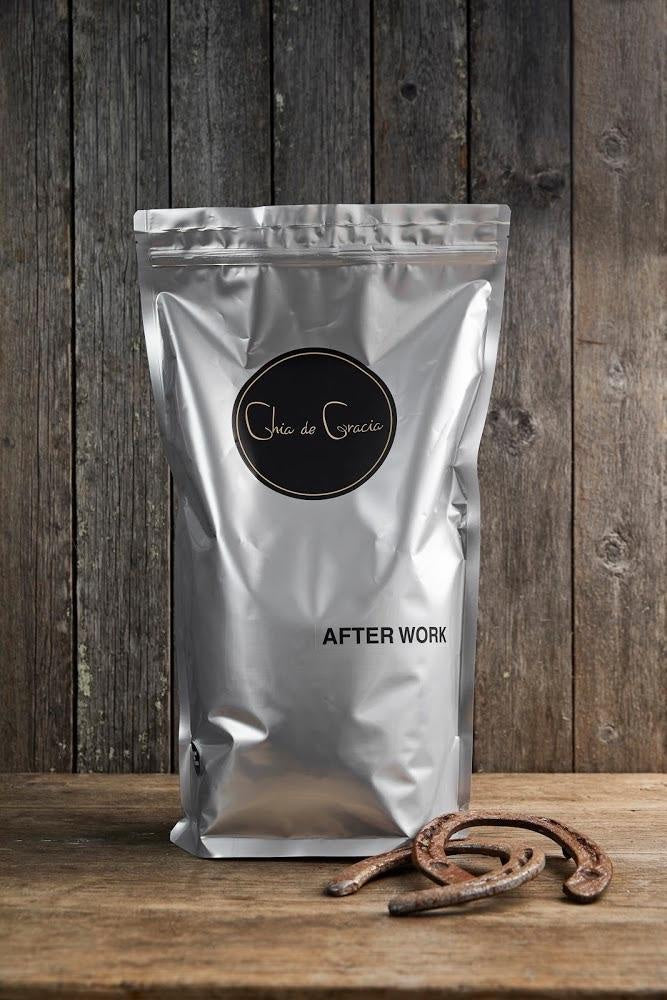
After Work
Delivery time 5-7 days
Couldn't load pickup availability
After Work – mash porridge for horse feeding
A warm porridge is a familiar pampering moment in many horses' daily routine – a palatable treat that many horses look forward to after training.
Mash or porridge mixed with warm water has been part of horse feeding for a long time. Traditionally, porridge blends have been prepared from grains, seeds and root vegetables that swell in water into a soft, easy-to-eat mixture.
After Work is a 100% natural, palatable porridge blend that brings milled linseed, barley malt, chia, brewer's yeast, liquorice root, apple, beetroot and mineral salt to the horse's diet, along with a pinch of love 🧡.
After Work contains highly digestible, high-fibre, stomach-friendly and recovery-supporting ingredients.
After Work ingredients:
After Work combines several raw materials typical of mash blends.
Seeds as the foundation of the mash blend
Milled linseed and chia are seeds that naturally contain fibre and fatty acids. When the seeds are moistened with water, they swell and form a soft, porridge-like texture. This is why linseed and chia are often used in mash-type porridge blends.
Barley malt
Malted barley brings nutrients typical of grain products as well as natural flavour to the porridge.
Brewer's yeast
Brewer's yeast naturally contains B-group vitamins and protein.
Beetroot and apple
Dried root vegetables and fruits add natural sweetness, fibre and nutrients typical of plants to the porridge.
Liquorice root
Liquorice root provides natural sweetness as well as compounds naturally found in plants, such as glycyrrhizin and flavonoids.
Mash and water in feeding
When After Work is mixed with warm water, it forms a soft and palatable porridge. The blend can be prepared as a thicker porridge or a thinner gruel by adding water as needed.
Electrolytes or other necessary dietary supplements can also be added to the porridge if needed.
A warm porridge is a welcome addition to the diet for many horses and a pleasant way to pamper your horse after training.
Dosage:
Horse approx. 500 kg
1–5 dl as needed
Mix with warm water and allow to steep until porridge-like.
Pack size
3,5 kg
Average nutritional values / 100 g
crude protein 16%, crude fat 15%, crude fibre 14,6%, ash 9,6%, sodium 2%, moisture 10%.
Background information and studies
Horse digestion is largely based on microbial activity in the large intestine, where plant fibres are fermented by microbes. Plant fibres are therefore a central part of the structure of the horse's nutrition.
Numerous equine studies have examined the effect of dietary composition on large intestine microbial activity and digestion. The quantity and quality of plant fibres influence the types of microbial populations present in the gut, as well as how nutrients are fermented in the large intestine.
Mash-type porridge blends are often prepared from seeds, grain products and plant-based raw materials that naturally contain fibre and nutrients typical of plants. When such raw materials are moistened with water, they swell and form a soft, porridge-like texture.
Seeds such as linseed and chia naturally contain plant fibre and fatty acids, which are part of the natural nutritional composition of seeds. Linseed forms a gel-like structure containing mucilage when in contact with water, which is a characteristic property of linseed.
References
Julliand, V., Grimm, P. (2017)
The impact of diet on the hindgut microbiome and digestive health of the horse.
Animal.
Harris, P., Ellis, A., Fradinho, M. et al. (2017)
Review: Feeding conserved forage to horses and digestive physiology.
Animal.
McGorum, B., Dixon, P., Robinson, N., Schumacher, J. (2015)
Equine Gastroenterology.
Saunders Elsevier.
National Research Council (2007)
Nutrient Requirements of Horses.
National Academies Press.
Jouany, J.P., Gobert, J., Medina, B., Bertin, G., Julliand, V. (2008)
Effect of live yeast culture supplementation on hindgut microbial communities and fermentation in horses.
Journal of Animal Science.
Share