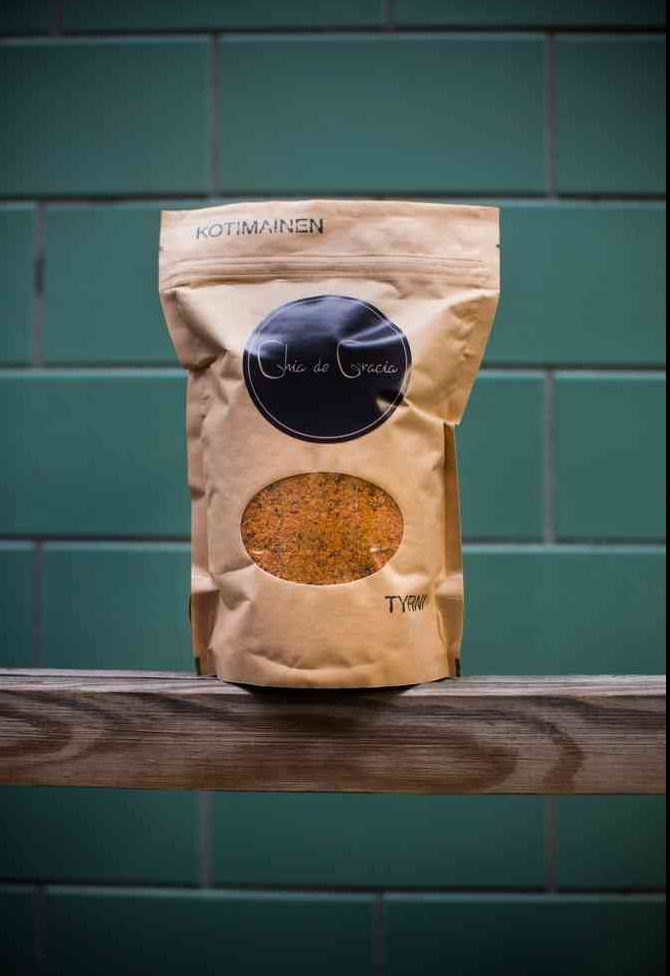


Chia de Gracia
Tyrnirouhe
Delivery time 5-7 days
Couldn't load pickup availability
Sea buckthorn powder (Hippophae rhamnoides) - a natural source of vitamins, antioxidants and fatty acids for horses and dogs
Sea buckthorn is a vitamin bomb like no other!
Thorn is an exceptionally nutritious berry that has long been used as part of both human and animal diets. Dried and ground sea buckthorn powder is suitable for use as part of a varied and natural diet for horses and dogs, especially when supplementing the diet with vitamins, antioxidants and plant-based fatty acids.
Sea buckthorn is known for its broad vitamin composition: it naturally contains almost all vitamins except vitamin D. Sea buckthorn is particularly rich in vitamins C and E and carotenoids such as beta-carotene. Fresh sea buckthorn contains up to 10-20 times more vitamin C than oranges. The flavonoids in sea buckthorn occur naturally in combination with vitamin C as part of the plant's nutritional composition. Sea buckthorn is one of the most vitamin E rich berries known.
These compounds form an antioxidant complex that is associated with normal tissue function and metabolic balance in the body as part of daily nutrition.
Skin, coat and mucous membranes from a nutritional perspective
The vitamins, flavonoids and fatty acids in Tyrn support the normal structure and function of the skin, coat and mucous membranes as part of the diet. Vitamins A, C, E and flavonoids in Tyrn are associated with skin and mucous membrane regeneration, protection of cells against oxidation and normal body immunity.
Historically, sea buckthorn was known in ancient Greece as a plant used to feed horses, and was found to make their coat smoother and shinier. According to current knowledge, these findings are linked to the high content of nutrients and bioactive compounds in sea buckthorn.
Fatty acids and mucosal nutritional support
Sea buckthorn contains an exceptionally broad fatty acid profile. The berry and seeds contain fatty acids from several omega series, including omega-3 (alpha-linolenic acid), omega-6 (linoleic acid), omega-7 (palmitoleic and vasic acid) and omega-9 (oleic acid).
Omega-7 fatty acid in particular is rare in the plant kingdom and is associated with normal mucosal structure and moisture balance as part of the diet. Tyrn fatty acids are also involved in the nutrition and metabolism of the subcutaneous fat layer, which is particularly important in dry-skinned animals and during the winter season.
Research background
Horses:
A controlled study in horses (Huff et al.) investigated the use of a sea buckthorn-based berry preparation as part of the diet. The study found that the feeding of sea buckthorn was associated with a reduction in the number of mucosal lesions of the glandular part of the stomach (pars glandularis) compared to the control group. No effect on the non-glandular part of the stomach (pars nonglandularis) was observed. The study was a dietary intervention and the results should not be used as a basis for treatment claims.
Dogs:
In a study in dogs, the use of sea buckthorn oil was considered as part of nutritional support for damaged mucosa. The study used sea buckthorn oil rather than dried berries, but supports the role of sea buckthorn fatty acids and bioactive compounds in mucosal nutrition.
Winter season nutrient supplementation
Dried sea buckthorn powder is particularly useful during the winter feeding season, when the intake of fresh herbal nutrition and natural vitamins is often lower. Sea buckthorn supplements the diet with vitamins, minerals and fatty acids as part of a complete and varied diet.
Dosage:
Horses: 1 tablespoon to 3 tablespoons per day.
Dogs: 1/2 tsp - 1 tbsp per day
Measurements: 1 tbsp ≈ 6 g, 1 dl ≈ 40 g
Nutrients (natural, approximate)
Dried sea buckthorn powder contains naturally (approximately per 100 g) e.g. Vitamin A 18,2 mg (alpha-carotene 2,3 mg, beta-carotene 15,9 mg), vitamin C 126,9 mg, vitamin E 25,8 mg, phosphorus about 2,5-3,0 g, potassium about 5,5-6,0 g, calcium 0.64 g, magnesium 0.71 g, copper 7.0 mg, manganese 10.0 mg, iron 48.0 mg, zinc 17.0 mg, and omega-3, omega-6 and omega-7 fatty acids.
Fatty acids as an indication:
Total fat content is approximately 3-8 g per 100 g of which omega-3 fatty acids are approximately 0,3-1,2 g, omega-6 fatty acids are approximately 0,8-2,5 g, omega-7 fatty acids are approximately 0,4-1,8 g and omega-9 fatty acids are approximately 0,3-1,2 g per 100 g of product.
The variation in content typical of a natural product is possible depending on the location, the crop, the drying method and the proportions of the berry parts.
Composition: dried and crushed sea buckthorn (Hippophae rhamnoides).
Background information and research references
The composition and nutritional properties of sea buckthorn (Hippophae rhamnoides) have been extensively studied both in botanical reviews and in animal and clinical studies. The publications below provide background information on the vitamins, fatty acids, flavonoids and their nutritional significance of sea buckthorn. They should not be used as a basis for claims for the treatment of specific animal diseases. In animal nutrition, sea buckthorn is used as part of a varied and balanced diet.
Horses
Huff, N.K. et al. (2012).
Effects of sea buckthorn berries on gastric ulcer scores and gastric juice pH in horses.
Journal of Veterinary Internal Medicine/Journal of Equine Veterinary Science (depending on publication channel).
- This study examined the use of sea buckthorn berry preparation in equine diets and its association with gastric mucosal ulceration. The effect observed was on the glandular part of the stomach (pars glandularis), not on the non-glandular part.
Dogs
Singh, P. et al. (2013).
Efficacy of Seabuckthorn (Hippophae rhamnoides) oil vis-à-vis other standard drugs for management of gastric ulceration and erosions in dogs.
Journal of Veterinary Pharmacology and Therapeutics.
- The study evaluated the use of sea buckthorn oil as part of the nutritional support of gastric mucosa in dogs. The study involved sea buckthorn oil, not dried berries.
Nutrients, antioxidants and bioactive compounds
Yang, B. & Kallio, H. (2001).
Composition and physiological effects of sea buckthorn (Hippophae rhamnoides L.) lipids. Trends in Food Science & Technology.
- A review on the fatty acid composition of sea buckthorn, especially omega-3, -6, -7 and -9 fatty acids.
Guliyev, V.B. et al. (2004).
Antioxidant activity of sea buckthorn (Hippophae rhamnoides) extracts.
Journal of Agricultural and Food Chemistry.
- A study on the antioxidant properties of sea buckthorn and the role of flavonoids, carotenoids and vitamins.
Sea buckthorn (Hippophae rhamnoides L.) as a potential source of nutraceuticals and its therapeutic possibilities - a review.
- A comprehensive review of the nutrients, vitamins, fatty acids and bioactive compounds of buckthorn.
Share