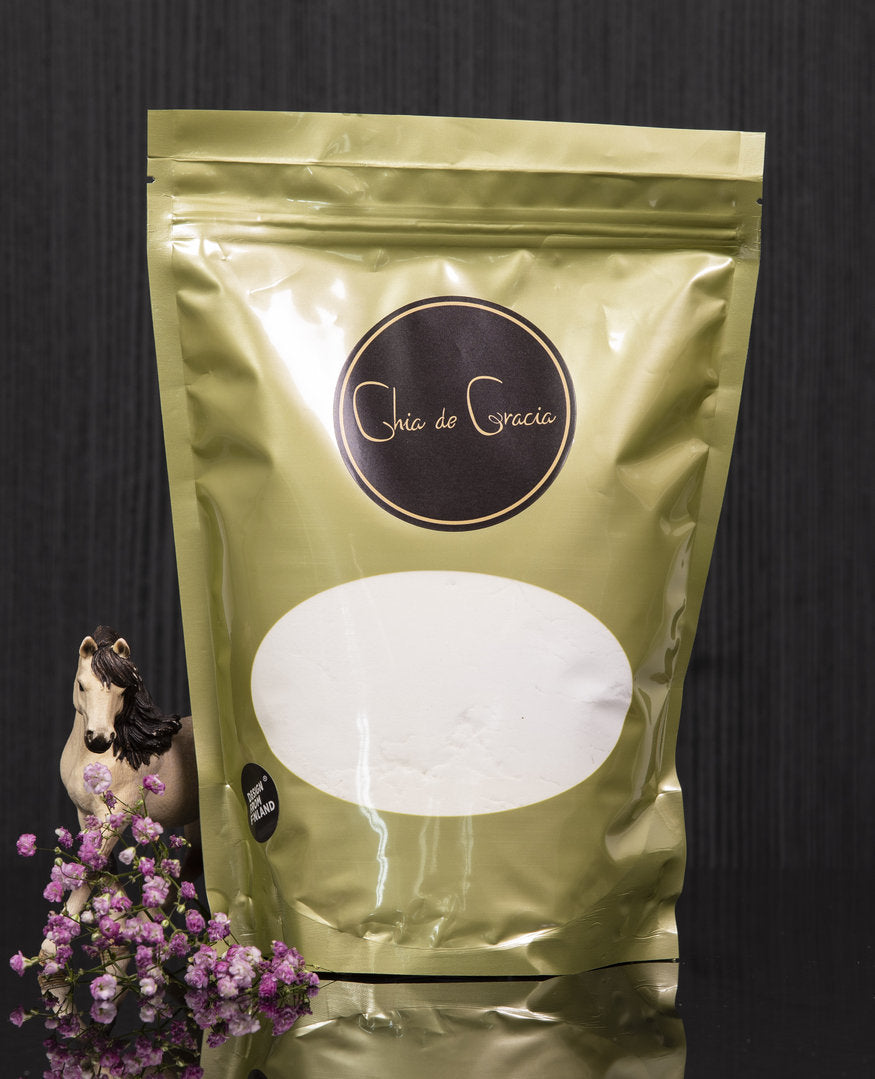

Chia de Gracia
Chondroitin sulphate
Delivery time 5-7 days
Couldn't load pickup availability
Chondroitin sulphate for horses and dogs
Chondroitin sulphate is a natural compound found in the horse's and dog's body as part of connective tissues and cartilage tissue. It belongs to glycosaminoglycans, which are key structural components particularly in the structure of joints and cartilage. Chondroitin is part of the cartilage structure and is associated with tissues that require flexibility, elasticity, and mechanical durability. In feeding, chondroitin sulphate is considered a building block of cartilage and joint structures and is used as part of a nutritional approach that takes into account joint structures and their normal function.
Joints and cartilage – what is it about?
A joint is the point where two bones meet. To ensure smooth movement and even load distribution, the ends of the bones are covered with cartilage tissue. The role of cartilage is to act as a flexible, pressure-equalising structure during movement. Cartilage tissue is neither hard bone nor soft muscle, but a specialised tissue whose structure is largely based on:
- water
- collagen
- glycosaminoglycans, such as chondroitin sulphate
Cartilage has no blood supply of its own; its nutrients come from surrounding tissues and synovial fluid. For this reason, cartilage tissue regenerates slowly and is sensitive to prolonged loading.
Loading, age, and chondroitin sulphate in the diet
Movement and loading are normal and necessary for joints, but at the same time they place demands on joint structures. In particular, the joint structures of actively moving, sport and leisure animals, as well as ageing horses and dogs, are in constant use. In nutrition, this is reflected in the need to consider the structural integrity of joints and cartilage tissue as part of the daily diet.
Chondroitin sulphate is often chosen for feeding in situations where the animal's daily life involves regular or increasing physical loading, prolonged exertion, or joint structures that change with ageing. Its use is based on chondroitin sulphate's role as part of the normal structure of joints and cartilage tissue, as well as its long history of use in animal nutrition.
Dosage:
Horse (approx. 500 kg):
15 g / day
1 tbsp ≈ 12 g (10 800 mg)
For long-term use, the dose can be halved.
Dogs:
under 3 kg: ¼ tsp / day
3–5 kg: ½ tsp / day
5–15 kg: 1 tsp / day
15–30 kg: 1,5 tsp / day
30–45 kg: 2 tsp / day
45–60 kg: 2,5 tsp / day
A minimum of three months' use is recommended, especially when joint structures are being considered in the diet over a longer period.
Composition: Chondroitin sulphate, of which: chondroitin 90 % 900 000 mg / kg
Background information and studies
The use of chondroitin sulphate has been examined in several studies as part of the nutritional evaluation of joint structures in horses and dogs, often in combination with glucosamine.
McCarthy G. et al. Influence of glucosamine and chondroitin sulfate on cartilage metabolism.
McCarthy G. et al. (2007) — Randomised double-blind, positive-controlled trial to assess the efficacy of glucosamine/chondroitin sulfate in dogs.
Bhathal A. et al. (2017) — Glucosamine and chondroitin use in canines for osteoarthritis: A review.
Share