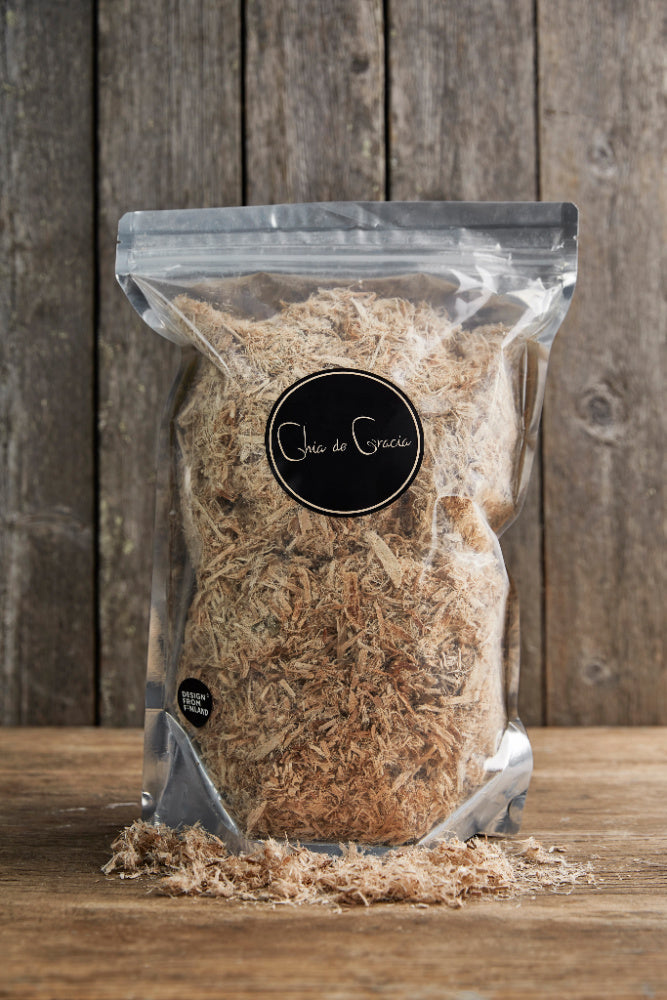

Chia de Gracia
Slippery elm 400 g
Delivery time 5-7 days
Couldn't load pickup availability
Slippery Elm for Horses (Ulmus rubra)
Slippery elm, also known as red elm, is a North American tree species whose bark is used as a feed ingredient due to its natural, mucilage-rich structure. Slippery elm is suitable as a complementary raw material as part of a horse's natural diet when you want to add soluble fibre and gently acting plant-based polysaccharides to the diet.
These are compounds naturally found in plants that bind water and form a soft, slippery mass when mixed with water or moist feed. In the case of slippery elm, this means the product swells in water, forming a gel-like, slippery mixture that makes the feed texture softer and more moist.
Soluble fibres affect the texture of feed – much like oat porridge or linseed, which swells in liquid.
Ground slippery elm bark forms a smooth and viscous gel with water, which is a typical property of mucilage-rich plant fibre sources.
Mucilage and Digestion – A Physiological Perspective
The most important property of slippery elm from a feeding perspective is its high mucilage content. Mucilage, the gel it forms, and soluble fibre effectively bind water and physically affect the structure of the feed mass.
The gel-like, moisture-binding structure affects how the feed mass progresses through the digestive tract and in what physical form it comes into contact with the surfaces of the digestive tract as part of normal digestive physiology.
This type of soluble fibre structure is a well-known property of plant-based feed ingredients used as part of the diet when the goal is to include gently acting, water-binding fibre in the diet.
The significance of slippery elm in feeding relates above all to the structure and composition of the feed mass, not to energy or nutrient intake as such.
Natural Composition from a Feeding Perspective
Slippery elm naturally contains:
-
mucilage-forming polysaccharides (soluble carbohydrates)
-
soluble fibre that binds water
-
tannins, which are polyphenolic compounds naturally found in plants
-
small amounts of minerals, such as calcium, magnesium and zinc
-
trace amounts of vitamins as part of the plant's natural composition
Nutrient contents are natural and vary between raw material batches. Practical Use in Feeding
Slippery elm is preferably mixed into moist feed or mash, allowing the mucilage to form evenly. This improves the mixability of the powder and makes it easy to use.
Slippery elm is also often used in feeding together with other plant-based fibre sources as part of the overall diet.
Dosage:
Horse:
2–3 g / 100 kg body weight / day
(500 kg horse: approx. 10–15 g / day)
1 tbsp ≈ 7 g
Also suitable for dogs
Slippery elm can also be used for dogs as part of the diet.
Dog:
1/2–1 tsp, 1–2 times per day
Composition
Ingredients: 100 % slippery elm bark (Ulmus rubra), dried and ground
No additives or preservatives.
Background Information and Studies:
The mucilage (elm mucilage) contained in slippery elm bark and the polysaccharides derived from it have been examined in several animal studies and observational field studies. These studies have described in particular the physical properties of the polysaccharide structure formed from slippery elm, such as its ability to bind water and form a viscous, gel-like mass.
In an open-label observational field study conducted on horses (McCullough R.W., 2013), in which polysaccharide material derived from slippery elm was examined as part of the overall feeding regimen, the gel-like structure was observed to spread extensively throughout the digestive tract area and was clearly detectable in the composition of the feed mass.
Similar observations have been reported in open-label field studies conducted on small animals, in which the physical behaviour of slippery elm's mucilage-based polysaccharide was examined in connection with feeding. In these datasets, the properties of mucilage were described particularly as a water-binding and structurally smoothing component.
These studies and sources are used here as background information to describe the polysaccharide-rich structure of slippery elm bark and its physical behaviour, not as a basis for efficacy or health claims regarding feeding.
McCullough, R. W. (2013).
Expedited management of ulcer, colic and diarrhea in 209 horses: An open-labeled observational study of a potency-enhanced sucralfate-like elm phyto-saccharide.
Journal of Veterinary Medicine and Animal Health, 5(7), 189–195.
https://academicjournals.org/article/article1373468374_McCullough.pdf
McCullough, R. W. (2013).
A potency-enhanced polyanionic phyto-saccharide of elm mucilage (PEPPS) prescribed in 209 horses in an open-labeled field trial.
Journal of Veterinary Medicine and Animal Health.
Beveridge, R. J.
A potency-enhanced polyanionic phyto-saccharide of elm mucilage (PEPPS) prescribed by small animal veterinarians in an open-labeled field trial.
Mad Barn Equine.
Research-Backed Ingredients: Slippery Elm.
Background review referencing McCullough et al.
Share